Modernize your martech stack
Migrate from Salesforce to Braze
You’re not stuck. In fact, you’re in good company. We’re former SFMC consultants who’ve been helping enterprise brands migrate to Braze since 2022. We know the platforms, we know the pitfalls, and we’ve seen what makes these migrations go well — and what doesn’t.
If you’re evaluating a move, start here.
65%+
of Stitch clients migrated from Salesforce Marketing Cloud to Braze
9 months
average migration timeline — with 3-18 month ranges depending on complexity
4.8/5 stars
on G2 from our SFMC-to-Braze migration clients
The martech landscape is changing
Why brands are leaving Salesforce Marketing Cloud for Braze
For many brands, it’s a natural time to evaluate whether to modernize your tech stack — not because your current one is broken, but because the world (and your customers) have changed.
The martech landscape has shifted
The platforms and architecture that made sense 10 years ago were built for a different world — one where data lived inside the marketing tool and email was the primary channel. Most modern B2C brands have outgrown that model.
Data infrastructure has evolved
If your data already lives in Databricks, Snowflake, or Redshift, you’re not migrating a data warehouse — you’re connecting a new engagement layer to where your data already lives. That’s a very different project than it was five years ago.
The gap between what you have and what you need is widening
Real-time triggers, unified cross-channel journeys, AI-powered personalization — these have moved from nice-to-have to baseline expectations. The question is whether your current platform can get you there.
Contract timing creates a natural window
Most teams that move successfully start evaluating 12–18 months before their contract expires. That runway lets you plan properly, overlap during transition, and use the migration as an opportunity to improve — not just replicate.
Building the business case
Getting leadership to approve a migration means translating what you feel every day into language that moves decisions. The challenge isn’t technical — it’s organizational. Here’s what the case typically needs to include.
Quantified capability gaps
2–3 specific programs you can’t run or can’t run well today — with revenue estimates attached to each.
Full cost of ownership
Beyond the license fee: staff overhead, specialist support, third-party tools filling gaps, training drag.
A phased approach
Show that business-as-usual is protected during the transition. Leadership says no to risk, not to change.
A clear ask
Budget, timeline, resourcing, and a named owner. Vague requests don’t get approved.
Why Stitch is the go-to migration partner
We left Salesforce for Braze. Now, we help brands do the same.
Our co-founders, Michael and Bobby, spent over two decades at ExactTarget and Salesforce — and ran one of the top SFMC consultancies in the world. They were believers.
Then they started seeing the cracks. Customers were starting to bolt on tools like Braze to their stack because SFMC couldn’t keep up. And despite every promise of an “all-in-one platform” and a “customer 360,” the data problems weren’t going away. They were just getting another rebrand.
That’s when the real issue became clear: marketers needed a tech stack that could actually keep up. The brands pulling ahead were building differently: a data warehouse at the center, best-in-class tools on top, and actual ownership of their customer data. Stitch launched in 2022 to help brands make that shift.
Customer love
“During our migration from SFMC to Braze, Stitch was absolutely critical in migrating and subsequently re-designing most of my campaigns due to overcomplexity in SFMC that didn’t work well with Braze. Their massive expertise and ability to take very challenging asks and make outcomes in such a quick amount of time was unbelievable. ” – Jennifer H.
Customer love
“Stitch helped us migrate off SFMC to Braze in a record 5-6 months. Between the complexity of our business and sometimes-not-so great data infrastructure, we have a lot of unique business cases that they were able to help solution for us. Now that we are on our new platform, this will revolutionize the way we communicate and engage with our Learners.” – Vera H.
Braze + Databricks: The modern CRM stack
The question isn’t just feature parity with what you have today. It’s whether the architecture fits the way the rest of your stack — and the rest of the industry — actually works now.
Why Braze
AI that’s actually in production
Braze has been building ML capabilities for over a decade. Agent Console takes marketers from idea to live campaign in 20 minutes. Braze Operator recommends next campaigns and journey improvements from inside your instance.
Teams become more self-sufficient
Campaigns that previously required specialist support to launch become things the broader marketing team builds. Braze is consistently described by teams post-migration as significantly more intuitive than what they were on before.
Your existing Salesforce integrations hold
Sales Cloud and Service Cloud integrations work with Braze — often surfacing richer, more timely engagement data than teams had before. We’ve done this integration many times across many configurations.
One profile. Every channel.
Every channel — email, SMS, push, in-app, content cards — runs off a single unified customer profile. When a new channel appears, standing it up is fast because the infrastructure is already there.
Often consolidates 4–5 platforms into one
Most brands we work with are running multiple messaging platforms alongside their primary ESP. Braze frequently replaces several of them — one platform, one partner, one place to build and measure.
Real-time is the default
A customer action can trigger a campaign in seconds. Behavioral triggers fire off the SDK or API immediately. That’s not a feature — it’s how the platform is architecturally built.
Why Databricks
Zero-copy triggers
Trigger journeys and campaigns based on data that stays in Databricks — no replication into Braze required. Your warehouse stays the source of truth, and your churn model actually fires a campaign instead of sitting in a dashboard nobody checks.
Cloud data ingestion, natively
Define a query in your warehouse and have it automatically sync into Braze profiles on your cadence. Databricks, Snowflake, Redshift, BigQuery, Microsoft Fabric — all natively supported. No custom pipelines, no engineering tickets.
Your data team’s work becomes live CRM capability
ML models built in Databricks can power segmentation, send-time optimization, and predictive triggers in Braze. The distance between a customer signal and a marketing response shrinks dramatically.
Three areas where brands consistently see ROI after migrating
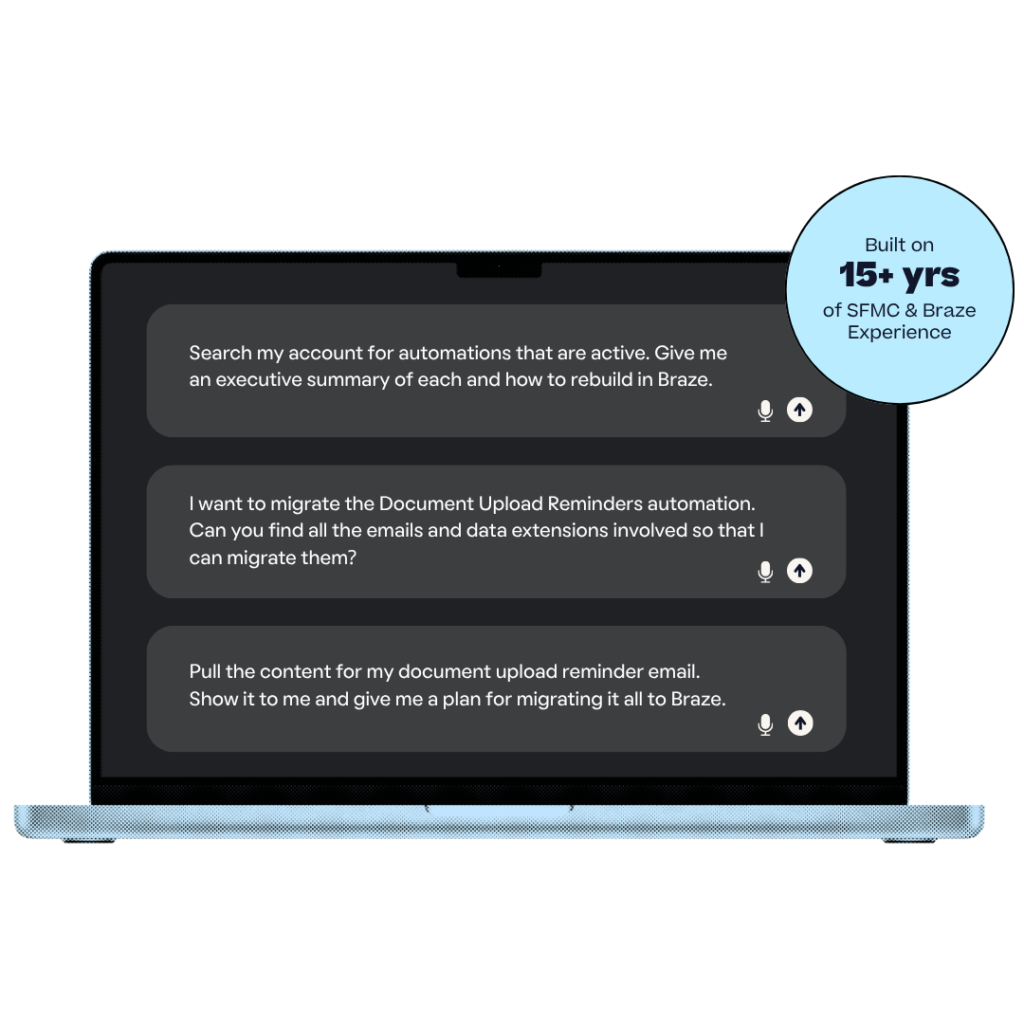
Meet Switch
Your Salesforce-to-Braze migration assistant. AI-powered, expert-trained on 15+ years of SFMC and Braze experience.
What Switch does:
- Knows exactly what’s in your SFMC instance: And where to move it, when to retire it, and how to rebuild it in Braze.
- Leads migration planning with a clear framework: Rooted in a decade of experience and real client migrations — not generic AI outputs.
- Translates assets faster: Expert logic built into every output so you’re not validating AI guesses with a SFMC specialist.
Go deeper
Resources for every stage of your evaluation
Every question answered
The questions marketers are asking before making the switch
These aren’t corporate FAQs. These are the actual questions we hear on every discovery call — and the honest answers, including the complicated ones.
We’re still under contract with SFMC. How do we think about timing of migrating off?
Most teams that migrate successfully start evaluating 12–18 months before their contract expires. Some overlap between contracts is unavoidable — but teams that give themselves that runway use the migration as a chance to reset and improve their marketing operations, not just lift and shift. We can help you think through the sequencing and build the internal business case well before you need to make a decision.
Salesforce is telling us to migrate to Marketing Cloud Next. Should we consider it?
It’s worth understanding what you’re actually being asked to do. Marketing Cloud Next is a rebuild of Marketing Cloud inside the core Salesforce platform, which means it runs on different UI patterns, has a different data model, and currently supports a fraction of the features most teams rely on in the legacy product. AMPscript, Content Builder, and mature journey logic are all either stripped down or absent. The brands we’re aware of who have evaluated it have largely deferred or stayed on legacy MC in parallel. If you’re being asked to pay for a migration regardless, that’s the moment to ask whether the destination is actually better. We don’t recommend it, and we’ll tell you why in as much detail as you need.
What’s actually different about Marketing Cloud Next vs what we’re on today?
From the “migrations” and proofs-of-concept that our team has done in former roles, the biggest differences are that Content Builder is gone, replaced by a drag-and-drop editor that’s less mature than most mid-market tools. AMPscript support covers only basic functions — a fraction of what the language can do. The platform is now natively inside Sales Cloud and Service Cloud, which is great for a sales team but a significant context shift for a marketing team. Most clients who have piloted it still run their legacy Marketing Cloud instance alongside it, which means it’s less of a transition and “running two platforms at once.” The honest truth is that the feature parity gap between Next and what you’re used to is substantial, and Salesforce hasn’t provided a clear roadmap for closing it.
We’re being pushed toward Data Cloud as part of our Salesforce renewal. Is it worth it?
Data Cloud has real technical capabilities — identity resolution, streaming ingestion, and a zero-copy connector to Databricks are legitimately useful. The challenge is the gap between the pitch and the implementation reality. Most large enterprises using Data Cloud today are primarily using it as a pipeline to activate data into Marketing Cloud — not unlocking the more sophisticated use cases. Onboarding is a significant undertaking even for straightforward scenarios, and it requires your marketing team to operate across two platforms with two learning curves. If you’re in a Salesforce renewal and being presented with Data Cloud as the answer to your data problems, we’d encourage you to evaluate whether your data problems actually require a second Salesforce platform — or whether they’d be better solved by connecting a best-in-class engagement tool to where your data already lives (like Databricks or Snowflake).
We already have Data Cloud. Does that make migrating to Braze harder or easier?
Easier, actually. If you’re already activating customer data in Data Cloud, you’ve already done the hardest part — you’ve built a unified view of your customer. Braze’s user profile architecture mirrors Data Cloud’s unified profile concept closely, so the data model work translates. And if you’re on Databricks, the zero-copy connector means you can activate that same data layer directly into Braze without replicating it. The segment and identity work you’ve done doesn’t go to waste — it becomes the foundation of how Braze personalizes.
What does Braze do that Data Cloud doesn’t?
They’re not really comparable — Data Cloud is a data layer, Braze is an engagement platform. But if the question is whether Braze can replace the activation use cases you’ve been told Data Cloud solves: yes, in many cases it can. Braze ingests data natively from your warehouse, supports real-time behavioral triggers, and has its own identity resolution capabilities on the roadmap. The meaningful difference is speed: Data Cloud’s activation into Marketing Cloud is a batch process — data takes hours to move. Braze fires in seconds. For lifecycle marketing, that gap matters more than most teams realize until they’re on the other side of it.
Is Salesforce’s “right time” framing a real advantage over Braze’s real-time architecture?
The idea is that sending at the exact right moment — not necessarily the fastest moment — is what drives results. We don’t disagree with the principle. Where we’d push back is on whether the Salesforce platform actually delivers on it. “Right time” requires rich, real-time behavioral data and the ability to act on it immediately. Braze processes behavioral signals in seconds and fires journeys in response. The ability to send at the right time depends on having the data infrastructure to know what that moment is — and for most brands, Braze + Databricks gets you there faster, with less technical overhead, than the Salesforce stack.
Is the security concern around Salesforce Marketing Cloud real, or overblown?
It’s real, and it’s worth factoring into renewal decisions — particularly if you’re in healthcare, financial services, or any regulated industry. In late 2025, a zero-day exploit targeting Marketing Cloud was disclosed, followed by a disruptive Salesforce patch in early 2026 that caused significant operational issues for many clients. The exploit method was subsequently published publicly. Salesforce’s response posture has been reactive — forced API credential rotations, sudden multi-factor auth rollouts — rather than proactive. That’s not a reason on its own to make a platform decision, but it’s a meaningful input for security and IT stakeholders who are part of your evaluation.
Will we be forced to move to Marketing Cloud Next?
The short answer: we don’t know. The long answer: probably not any time soon. But, Salesforce has made clear that their focus for product investments will be in their data and AI infrastracuture, and they will stop reporting on marketing earnings as its own line item. So that tells us they will no longer be evolving their legacy Marketing Cloud tools, and will likely funnel any future marketing product investments into Marketing Cloud Next. We’re assuming that you’re here because you want to invest in marketing, so we recommend taking into account whether or not your martech vendors will push you forward or hold you back.
How do we build the business case internally for migrating off SFMC?
The framing that tends to work: “Our current setup is limiting what marketing can deliver, and here’s the cost of that.” Leadership needs to see quantified gaps — the revenue impact of 2–3 programs you can’t run or can’t run well, the full cost of ownership beyond the license fee, and a phased approach that shows business-as-usual is protected during the transition. We help clients build this case. Present it as a series of smaller decisions, not one enormous lift.
We’ve been on our SFMC for a long time. Is our data portable?
Generally yes — modern marketing platforms have open APIs and data is extractable. We’ve pulled down large client instances with hundreds of automations running and used AI to audit which ones were actually driving value. The more important question is what to bring vs. what to leave behind. Not everything in your current instance belongs in Braze — some of it belongs in your data warehouse. Migration is the right moment to sort that out.
How long does a migration off Salesforce Marketing Cloud actually take?
The honest range is 3 to 18 months, depending on the complexity of your business and how many platforms you’re integrating. The most common pattern: teams that expect 18 months land in 9. The single biggest variable isn’t campaign volume — it’s whether your data already lives in a modern warehouse. If you’re on Databricks or Snowflake, you’re connecting Braze to where your data already lives. That’s a significant lift off the project.
Will there be disruption to our sending? We can’t pause campaigns.
The goal is always to keep sends running, and we structure migrations to run both platforms in parallel during IP warming — sending from both simultaneously during the transition. Our approach to scoping a migration is to take a “zero risk” approach — starting with careful, thoughtful planning for resourcing, integrations, seasonality, and other internal initiatives, then activating that plan with tight project management and clear communication.
What happens to our CRM integrations?
Existing CRM integrations — Sales Cloud, Service Cloud — hold. Braze connects to the same APIs, so your customer service agents typically don’t see a difference. Our preferred approach is a Lightning component inside your CRM that pulls engagement data from Braze or your warehouse on demand, giving agents a richer, more timely view than most teams had before.
Do we need a CDP or data warehouse to use Braze?
Not necessarily, but if you already have one — Databricks, Snowflake, Redshift, BigQuery, Microsoft Fabric — Braze is built to work with it natively. You can query your warehouse directly, sync data into Braze profiles on a cadence you control, or use zero-copy triggers to fire a journey based on warehouse data without ever moving it into Braze. Whether you need a CDP depends on your stack and use case — a separate conversation we’re happy to have.
Does cross-channel actually work natively in Braze?
Yes — all channels in Braze run off a single customer profile and a single data model. Email, SMS, push, in-app messages, content cards — one profile, one place to build and measure. As new channels emerge, they’re fast to stand up because the infrastructure is already there.
Our team has deep platform expertise in SFMC. Will that transfer?
More than you’d expect. The core principles of lifecycle marketing don’t change — audience segmentation, journey logic, KPIs, campaign strategy all carry over. What changes is the tool. A lot of the Stitch team has deep backgrounds in Salesforce AND Braze, and have found that transitioning from focusing on Salesforce to focusing on Braze didn’t result in lost momentum for them — but rather, has helped them learn new platforms quickly.
What questions should we ask migration partners?
The biggest signal is specificity. Vague answers about “best practices” usually mean a vendor hasn’t actually done the work. Look for a partner who can get granular about how things will function post-migration, not just how the migration itself will run.
What happens to my data architecture, not just my data?
A real migration partner redesigns your data model for how Braze thinks about users, events, and canvases, rather than lifting and shifting your SFMC structure as-is. If a partner can’t explain how your data model changes, expect personalization problems to show up months after cutover.
How do you decide what not to migrate?
Every SFMC instance accumulates dead journeys and segments nobody remembers building. A partner who migrates everything 1:1 is avoiding a harder conversation about what’s actually driving revenue. Ask for a prioritization framework, not a promise to “migrate it all to be safe.”
Who owns the Braze instance 30 days after cutover?
Cutover day gets all the attention, but the month after is usually where migrations succeed or fail. A strong partner builds in enablement and knowledge transfer so your team has real ownership, not a handoff doc nobody opens.
What’s the plan if a journey breaks in production?
Speed and care can conflict in practice. Ask what happens when a critical lifecycle journey misfires mid-migration. The answer reveals whether their methodology is a real operating discipline or just a talking point.
How do you sequence migration around an active campaign calendar?
Your team doesn’t get to pause marketing during a migration. A good partner plans around your always-on flows and campaign calendar instead of treating the project like a clean greenfield build.